Corporate Rules
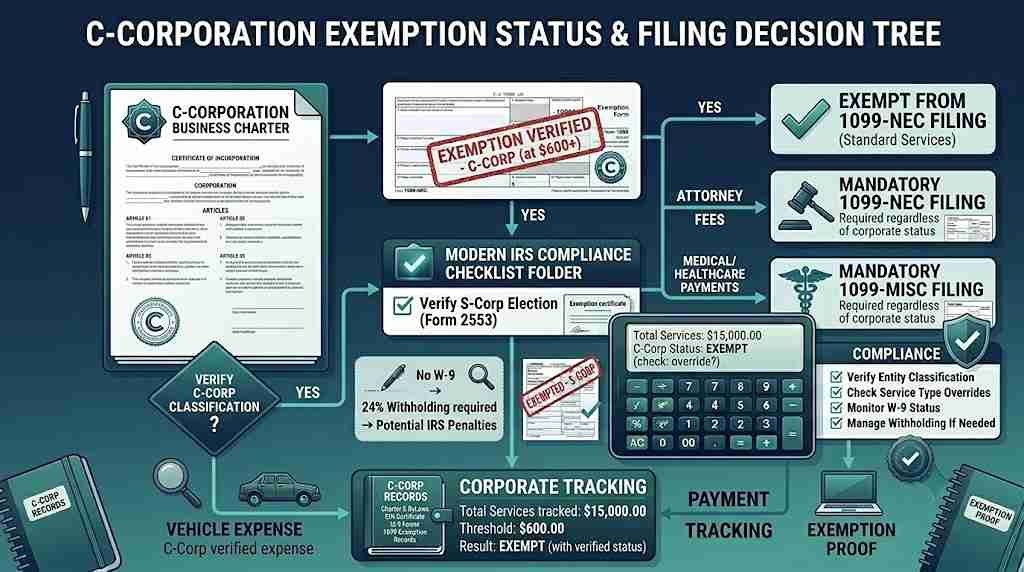
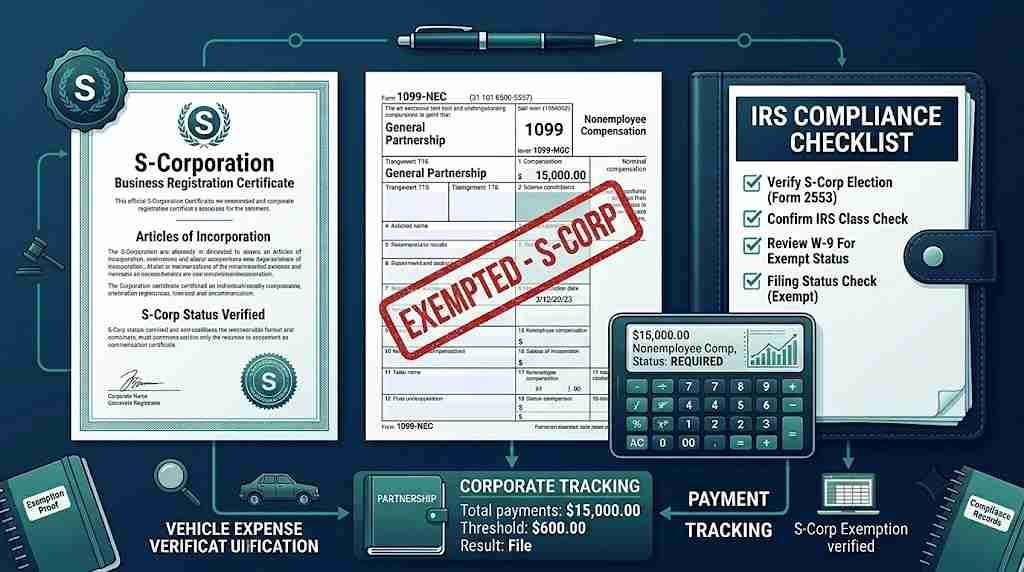
Corporations do not follow the same 1099 rules as sole proprietors and partnerships, and the details depend on which kind of corporation you are dealing with. C-corporations are generally exempt from receiving 1099-NEC and 1099-MISC, with narrow exceptions for attorneys and medical providers. S-corporations pass income through to shareholders on Schedule K-1, which raises its own questions: reasonable compensation for owner-employees, the Form 1120-S filing deadline, and how distributions differ from salary. This section answers those entity-specific questions one at a time, with the IRS rule behind each answer. If your question is about 1099s in general rather than about a corporation, start in 1099 Basics; if it is about LLCs or partnerships, those sections cover it.

Frequently Asked Questions
How does an S-corp save on taxes?
An S-corporation is a pass-through: profits flow to shareholders on Schedule K-1 and escape entity-level tax, and only the shareholder-employee's reasonable W-2 salary is subject to FICA; remaining distributions are not subject to self-employment or FICA tax.
What is reasonable compensation for an S-corp owner?
A shareholder-employee must take a reasonable W-2 salary for services rendered, judged on the facts and circumstances of the business; there is no statutory formula for the amount.
When is Form 1120-S due?
March 15 for a calendar-year S-corporation; Form 7004 extends the deadline to September 15.
Can an LLC be taxed as an S-corporation?
Yes. An LLC can elect S status by filing Form 2553 under the check-the-box rules, provided it meets the S-corporation eligibility limits.
How many shareholders can an S-corporation have?
No more than 100 shareholders, with one class of stock, under IRC section 1361.