1099 How Much to Set Aside for Taxes: The 2026 Guide
1099 how much to set aside for taxes? Set aside 25% to 30% of every payment you receive. That is the rule of thumb for most 1099 independent contractors in 2026. The reason the number is that high: nobody withholds tax from your pay, so you owe both federal income tax and the 15.3% self-employment tax (12.4% Social Security + 2.9% Medicare) on your net earnings — and state income tax on top in most states. This guide shows you exactly how the 25–30% figure is built, how to calculate your own percentage, and how to pay it quarterly so you never face a surprise bill.
Key takeaways
- The standard baseline is 25% to 30% of each 1099 payment, set aside the day the money arrives.
- Self-employment tax is 15.3% on 92.35% of net earnings — about 14.1% of your net profit — and it applies before income tax.
- Your real percentage depends on your income: roughly 25% at $60,000 net, 25–30% at $80,000–$100,000 net, and 30%+ above that.
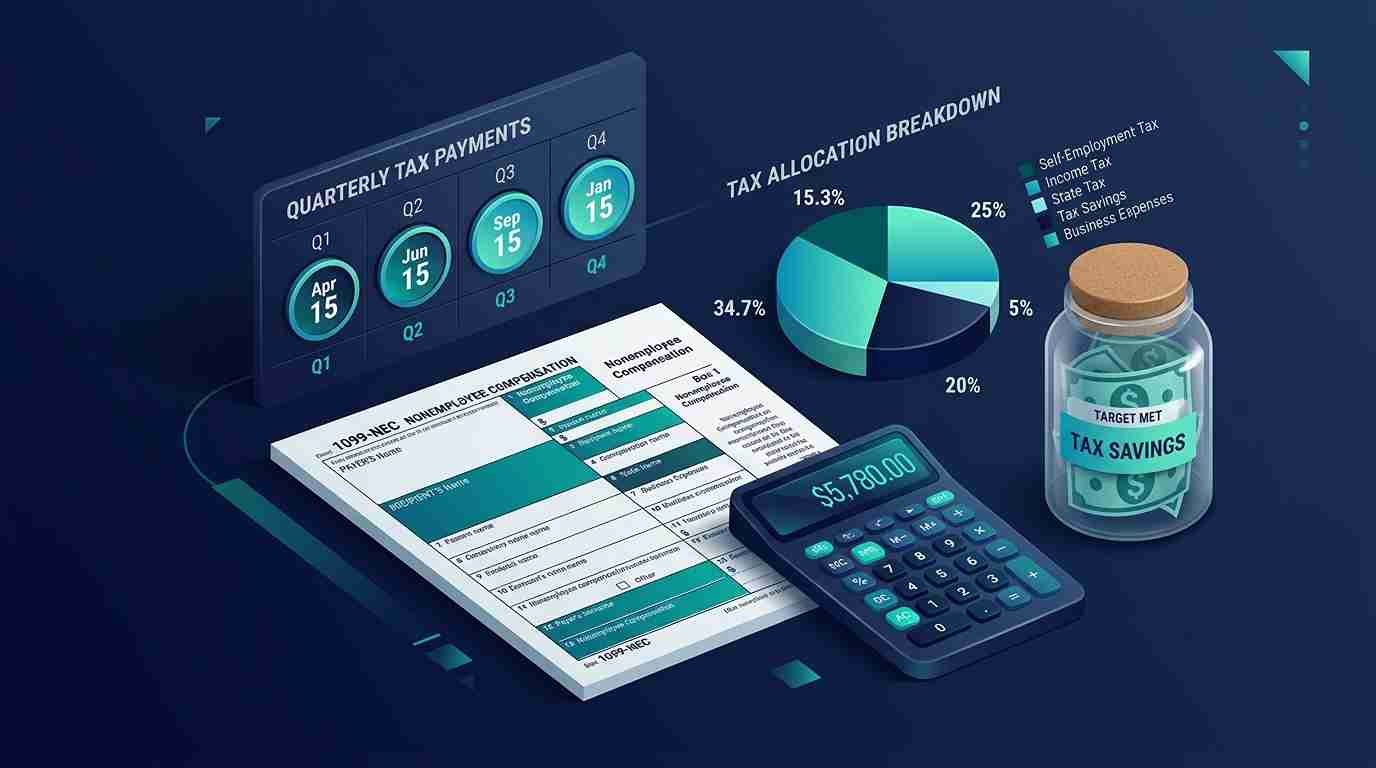
- Quarterly estimated payments are due April 15, June 15, September 15, 2026 and January 15, 2027 (Form 1040-ES).
- Business deductions and retirement contributions lower your taxable income — and therefore lower the amount you need to set aside.
Why 1099 Workers Owe So Much More Than They Expect
A W-2 employee never sees the tax problem: federal income tax, Social Security and Medicare are withheld from every paycheck, and the employer pays half of Social Security and Medicare on top. A 1099 independent contractor gets the full gross payment with zero withheld — and is responsible for both halves of Social Security and Medicare, plus income tax, plus quarterly payments.
That is why the first year of freelancing produces so many painful tax bills. The money felt like income; roughly a quarter of it was always the government’s. The fix is not complicated, but it has to be systematic: reserve the tax share before you spend anything, and pay it to the IRS four times a year.
The Three Layers of 1099 Tax
Every dollar of set-aside covers three layers. Understanding them separately is the key to calculating your own percentage instead of guessing.
Layer 1 — Self-employment tax (IRC § 1401)
Every 1099 contractor owes 15.3% self-employment tax on net self-employment income: 12.4% for Social Security and 2.9% for Medicare. But the rate does not apply to your full profit. It applies to 92.35% of net earnings — net profit after Schedule C business deductions, multiplied by 92.35%. The 7.65% reduction mirrors the employer half of payroll tax that a W-2 employer pays.
Two limits apply:
- The 12.4% Social Security portion only applies up to the 2026 wage base of $184,500 (combined wages and self-employment income; W-2 wages use up the base first).
- The 2.9% Medicare portion has no cap — it applies to all net earnings.
- You owe self-employment tax only if your net earnings are $400 or more in the year (Schedule SE).
Layer 2 — Federal income tax (IRC § 1)
Federal income tax is calculated on your taxable income after two deductions that shrink the base:
- Half of your self-employment tax is deductible from gross income (IRC § 164(f)).
- Schedule C business deductions — home office, vehicle, equipment, health insurance, retirement contributions — reduce net self-employment income before either tax is calculated.
The remaining taxable income is taxed at the 2026 marginal brackets, from 10% to 37%. Your marginal rate is the rate on your last dollar; your effective rate — total income tax divided by total income — is always lower, because the first dollars are taxed at 10% and 12%.
Layer 3 — State income tax
Most states add their own income tax on self-employment income. Rates range from zero in the nine states with no income tax on earned income to a top marginal rate of 13.3% in California. State tax is calculated and paid separately, usually with its own quarterly estimated payments. If you live in a no-income-tax state, the 25–30% federal rule of thumb is roughly complete; in a high-tax state, add your state rate on top.
The 25–30% Rule of Thumb — and When It Is Wrong
The 25–30% rule works because the two federal layers add up to roughly that range for a typical contractor. Self-employment tax alone is about 14.1% of net profit (15.3% × 92.35%). Add federal income tax at an effective rate of roughly 10–16% for most middle-income contractors, and you land at 24–30%.
But a rule of thumb is a starting point, not an answer. Your true percentage depends on:
- Your income level. Higher income pushes you into higher brackets, so the percentage rises.
- Your deductions. Every legitimate Schedule C deduction lowers both taxes, so heavy deductions mean a lower percentage.
- Your filing status and other income. A spouse’s W-2 income, or a second income source, changes your bracket.
- Your state. State tax can add 0% to 13% on top.
- Retirement contributions. A Solo 401(k) or SEP IRA contribution cuts federal income tax (though not self-employment tax).
Use the table below as a starting point, then work through the examples to pin down your own number.
| Net self-employment income (single filer, standard deduction) | Self-employment tax | Federal income tax (approx.) | Combined federal total | Suggested set-aside |
|---|---|---|---|---|
| $40,000 | $5,652 | ~$2,281 | ~$7,933 (20%) | 25% |
| $60,000 | $8,478 | ~$4,511 | ~$12,989 (22%) | 25% |
| $80,000 | $11,304 | ~$7,527 | ~$18,831 (24%) | 25–27% |
| $100,000 | $14,130 | ~$11,616 | ~$25,745 (26%) | 27–30% |
| $150,000 | $21,194 | ~$22,191 | ~$43,385 (29%) | 30–33% |
| $250,000 | $29,573† | ~$46,572 | ~$76,146 (30%) | 30–35% |
Federal income tax figures assume the standard deduction for a single filer ($16,100 in 2026), no other income, and no retirement contributions. Your actual bill will differ. † At $250,000 the Social Security portion is capped at the $184,500 wage base, so SE tax grows more slowly above that point.
Quick Reference Compliance Matrix
| Income Level | SE Tax Obligation | Federal Income Tax | Recommended Set-Aside % |
|---|---|---|---|
| $0 — $20,000 net | 15.3% on 92.35% | 10% bracket | 25% minimum |
| $20,001 — $50,400 net | 15.3% on 92.35% | 12% bracket | 25% — 27% |
| $50,401 — $105,700 net | 15.3% on 92.35% | 22% bracket | 27% — 30% |
| $105,701 — $184,500 net | 15.3% on 92.35% | 24% bracket | 30% — 33% |
| $184,501 — $200,000 net | 2.9% Medicare only | 32% bracket | 33% — 35% |
| $200,001 — $500,000 net | 2.9% + 0.9% Additional Medicare Tax | 35% bracket | 35% — 38% |
| $500,001+ net | 2.9% + 0.9% Additional Medicare Tax | 37% bracket | 38% — 40% |
Worked Example 1: $80,000 Net Income (Single Filer)
This is the calculation every 1099 contractor should be able to do. A freelancer with $80,000 of net profit on Schedule C, single, taking the standard deduction, no other income:
Step 1 — Self-employment tax
- Net earnings: $80,000 × 92.35% = $73,880
- SE tax: $73,880 × 15.3% = $11,304
- Social Security: $73,880 × 12.4% = $9,161
- Medicare: $73,880 × 2.9% = $2,143
Step 2 — Federal income tax
- Deductible half of SE tax: $11,304 ÷ 2 = $5,652
- Adjusted gross income: $80,000 − $5,652 = $74,348
- Standard deduction (single, 2026): $16,100
- Taxable income: $74,348 − $16,100 = $58,248
- Tax by bracket: 10% × $12,400 = $1,240; 12% × $38,000 = $4,560; 22% × $7,848 = $1,727
- Federal income tax: $7,527
Step 3 — Total and percentage
- Total federal tax: $11,304 + $7,527 = $18,831
- Effective rate: $18,831 ÷ $80,000 = 23.5%
- Set aside 25% ($20,000) and you cover the bill with about $1,170 to spare. Set aside 30% ($24,000) and you have a comfortable cushion for state tax or an income surprise.
Worked Example 2: $60,000 Net Income (Single Filer)
A newer contractor with $60,000 of net profit:
- Net earnings: $60,000 × 92.35% = $55,410
- SE tax: $55,410 × 15.3% = $8,478
- Deductible half of SE tax: $4,239; AGI: $60,000 − $4,239 = $55,761
- Taxable income: $55,761 − $16,100 = $39,661
- Federal income tax: 10% × $12,400 = $1,240; 12% × $27,261 = $3,271 → $4,511
- Total federal tax: $8,478 + $4,511 = $12,989 — 21.6% of net income
- Set aside 25% ($15,000) and you are covered federally, with about $2,000 left toward state tax.
The lesson from both examples: self-employment tax is the floor. Even at $60,000, SE tax alone is 14.1% of net profit. Federal income tax is the variable layer — and the standard deduction is doing real work here, shielding the first $16,100 of income.
The 2026 Federal Tax Brackets for 1099 Income
These are the brackets that apply to 2026 income (returns filed in early 2027), from IRS Revenue Procedure 2025-32. They apply to taxable income — after the standard deduction or itemised deductions.
| Rate | Single | Married filing jointly |
|---|---|---|
| 10% | $0 – $12,400 | $0 – $24,800 |
| 12% | $12,401 – $50,400 | $24,801 – $100,800 |
| 22% | $50,401 – $105,700 | $100,801 – $211,400 |
| 24% | $105,701 – $201,775 | $211,401 – $403,550 |
| 32% | $201,776 – $256,225 | $403,551 – $512,450 |
| 35% | $256,226 – $640,600 | $512,451 – $768,700 |
| 37% | Over $640,600 | Over $768,700 |
The 2026 standard deduction is $16,100 for single filers and $32,200 for married couples filing jointly.
Remember the difference between marginal and effective rates. A single contractor with $58,248 of taxable income is “in the 22% bracket” — but only the income above $50,400 is taxed at 22%. Most of it is taxed at 10% and 12%, which is why the effective federal income tax rate in Example 1 is only about 12.9% of taxable income, not 22%.
The Additional Medicare Tax Above $200,000
At higher incomes a third federal layer appears: the Additional Medicare Tax of 0.9% on self-employment income above $200,000 for single filers (or $250,000 for married couples filing jointly). It applies to the amount above the threshold, based on net earnings from self-employment — the same 92.35%-adjusted figure used for regular SE tax.
Example: a single contractor with $300,000 of net profit has net earnings of $277,050 ($300,000 × 92.35%). The amount above the $200,000 threshold is $77,050, and the Additional Medicare Tax is $77,050 × 0.9% = about $693. It is a small amount next to the main bill, but high earners who ignore it will underpay by exactly that much — and the 25–30% rule starts to stretch thin above $200,000, which is why the table above moves to 30–35% at the top end.
Quarterly Estimated Tax Payments: Pay As You Go
Calculating the amount is only half the job. The IRS runs a pay-as-you-go system: because no employer withholds tax for you, you must pay your estimated tax in four quarterly instalments using Form 1040-ES (or online through IRS Direct Pay or EFTPS).
2026 quarterly due dates
| Quarter | Income period | Due date |
|---|---|---|
| Q1 | January 1 – March 31, 2026 | April 15, 2026 |
| Q2 | April 1 – May 31, 2026 | June 15, 2026 |
| Q3 | June 1 – August 31, 2026 | September 15, 2026 |
| Q4 | September 1 – December 31, 2026 | January 15, 2027 |
If a due date falls on a weekend or federal holiday, it moves to the next business day. If you file your return and pay the full balance by January 31, 2027, you do not need to make the separate January 15 payment.
You generally must make estimated payments if you expect to owe $1,000 or more in tax for the year after subtracting withholding and credits. See quarterly estimated taxes for 1099 workers for deadlines, Form 1040-ES, and how to pay.
You can estimate quarterly payments on 1099 income with our quarterly estimated tax calculator.
The safe harbours that protect you from penalties
The underpayment penalty (IRC § 6654) applies if you pay too little, too late. But two safe harbours protect you:
- 90% of the current year’s tax. Pay at least 90% of what you will owe for 2026, in four roughly equal instalments, and there is no penalty.
- 100% of last year’s tax (110% if your adjusted gross income was over $150,000). Pay last year’s total tax bill in four equal instalments and there is no penalty — even if your income doubles this year.
For most contractors, the prior-year safe harbour is the simplest strategy: take last year’s total tax from your return, divide by four, and pay that each quarter. If this is your first year with no prior-year tax, use the 90%-of-current-year method and re-estimate each quarter as income comes in.
The Practical Set-Aside System: A Separate Account
The system that actually works is boring — and that is why it works.
- Open a separate savings account used only for tax reserves. A separate business checking account works too; the point is that tax money never sits in the account you spend from.
- Transfer your percentage the day a payment clears. If a client pays $5,000 and your rate is 30%, move $1,500 to the tax account immediately. Do not wait until month-end.
- Pay quarterly from the tax account only. When a due date arrives, the money is already there.
- Reconcile once a quarter. Compare what you have set aside with what you actually owe using Form 1040-ES. If income jumped, raise the percentage for the next quarter — you can always adjust future payments.
- Never borrow from the tax account. It is not savings and it is not an emergency fund. It is money you are holding for the IRS.
The standard 30% rule is the simplest version of this system: transfer 30% of every gross payment, no exceptions, no mental maths. If your calculated rate is lower, the extra is a refund at filing time. If your rate is higher, you will have caught it at the quarterly reconciliation.
Deductions That Lower the Amount You Set Aside
Every legitimate business deduction reduces your net self-employment income — which reduces both self-employment tax and federal income tax. That is why tracking deductions is not bookkeeping trivia; it directly lowers the percentage you need to reserve.
The deductions that move the number most for 1099 contractors:
- Home office — the simplified option or actual expenses for a dedicated workspace.
- Vehicle expenses — standard mileage rate or actual costs for business driving.
- Health insurance premiums — deductible for self-employed people who are not eligible for an employer plan.
- Retirement contributions — a Solo 401(k) or SEP IRA contribution reduces federal income tax (though not self-employment tax).
- Business equipment, software and supplies — including the cost of tools you use only for work.
- Half of self-employment tax — the automatic deduction described above.
A worked illustration: a contractor with $150,000 of net income who makes the maximum Solo 401(k) contribution for 2026 — a $24,500 employee deferral plus an employer profit-sharing contribution of about $27,881, for a total of about $52,381 — cuts their taxable income from about $123,303 to about $70,922. Federal income tax falls from about $22,191 to about $10,315, a saving of roughly $11,876. Total federal tax drops from about $43,385 (28.9% of net income) to about $31,509 (21.0%). The set-aside rate falls from 30% to about 25% — and the “saving” is now sitting in a retirement account instead of going to the IRS.
State Income Tax: The Third Layer
State tax is the part of the set-aside that varies most by location. Nine states have no income tax on earned income, so contractors there can use the federal 25–30% figure as-is. Most other states add somewhere between 2% and 10%, and California’s top marginal rate reaches 13.3% for very high earners.
Practical approach: find your state’s top marginal rate for your income, then add it to your federal percentage — or, more precisely, add your state’s effective rate. Most states also require their own quarterly estimated payments, usually on the same dates as the federal ones. Check your state tax agency’s website for its own estimated-payment form and deadlines; they do not always match the IRS.
Nine states impose zero state income tax on self-employment income — Alaska, Florida, Nevada, New Hampshire, South Dakota, Tennessee, Texas, Washington, and Wyoming. Contractors operating exclusively in these states can reduce their total set-aside percentage by 4% to 8% compared to contractors in high-tax states.
Common Mistakes That Create a Surprise Tax Bill
- Spending gross income as if it were net. The single most common error. The 25–30% was never yours.
- Skipping quarterly payments and hoping to settle up in April. The penalty and interest apply even if you pay in full at filing time.
- Setting aside a percentage of gross revenue instead of net profit — or the reverse. Base the percentage on net profit after business expenses, but transfer it from each gross payment as it arrives.
- Forgetting state tax entirely, then discovering a second bill from the state.
- Using last year’s percentage after a big income jump. A raise in income pushes you into a higher bracket; re-check the percentage every quarter.
- Ignoring the $400 threshold myth in reverse. You owe income tax on net earnings even below the $400 SE-tax threshold — $400 is only the point where self-employment tax starts.
- Not adjusting after a big deduction. A large retirement contribution or equipment purchase lowers your bill — recalculate, or you will overpay all year (which is safe, but ties up cash you could use).
Frequently Asked Questions
1099 how much to set aside for taxes if this is my first year with no prior-year tax liability?
Use the 25–30% rule from your very first payment, and pay quarterly using the 90%-of-current-year safe harbour: estimate your annual income, calculate the tax, and pay a quarter of it at each due date. Re-estimate every quarter as real income comes in — first-year income is the hardest to predict, so check your numbers in June and September rather than waiting until January.
1099 how much to set aside for taxes when income fluctuates month to month?
Set aside a fixed percentage of each payment as it arrives, not a fixed dollar amount per month. In a $10,000 month you reserve $3,000; in a $1,000 month you reserve $300. For quarterly payments, the IRS annualised-income method (Schedule AI of Form 2210) lets you pay based on when the income was actually earned, so a big fourth quarter does not create a penalty for the earlier, smaller quarters.
1099 how much to set aside for taxes after maximising a Solo 401(k) contribution?
Less — but only on the federal income tax side. A Solo 401(k) contribution reduces taxable income for federal income tax, not self-employment tax. In the $150,000 example above, maximising the Solo 401(k) cut the total federal set-aside rate from about 29% to about 21%. Re-run the calculation with the contribution subtracted before applying the tax brackets, and lower your quarterly payments accordingly — but keep the self-employment tax portion untouched.
Do I have to set aside taxes if I also have a W-2 job?
Yes, on the 1099 income — but your W-2 withholding may already cover part of the bill. If your employer withholds enough to cover the tax on your combined income, you may owe little or no estimated tax on the 1099 side. The cleanest approach: add the expected 1099 tax to your W-2 withholding (by adjusting your Form W-4) or pay it as estimated tax. Either way, the 1099 income is taxed — the only question is which channel the money travels through.
What happens if I do not set aside enough?
You will owe the balance at filing time, plus an underpayment penalty and interest under IRC § 6654 if you paid less than the safe-harbour amounts. The penalty is calculated quarterly, so paying late in the year does not erase the penalty for the earlier quarters. If you discover a shortfall before year-end, increase your remaining quarterly payments — a larger Q4 payment reduces the penalty, even if it does not eliminate it entirely.
Last reviewed: November 23, 2026
This article is educational information, not tax advice. Tax rates and thresholds change annually; confirm current figures with the IRS or a qualified tax professional before relying on them.
Sources: IRS — Self-employment tax: https://www.irs.gov/businesses/small-businesses-self-employed/self-employment-tax-social-security-and-medicare-taxes | Social Security Administration — If You Are Self-Employed (Publication No. 05-10022): https://www.ssa.gov/pubs/EN-05-10022.pdf | IRS — Revenue Procedure 2025-32: https://www.irs.gov/pub/irs-drop/rp-25-32.pdf | IRS — Form 1040-ES, Estimated Tax for Individuals: https://www.irs.gov/pub/irs-pdf/f1040es.pdf | IRS — Publication 505, Tax Withholding and Estimated Tax: https://www.irs.gov/publications/p505 | IRS — Retirement topics, 401(k) and profit-sharing plan contribution limits: https://www.irs.gov/retirement-plans/plan-participant-employee/retirement-topics-401k-and-profit-sharing-plan-contribution-limits