Are 1099 employees self-employed? Yes — in most cases, a person who receives a 1099 is self-employed for tax purposes. The IRS treats workers paid on Form 1099-NEC as independent contractors, not employees, which means they report income on Schedule C, pay the 15.3% self-employment tax themselves, make their own quarterly estimated payments, and receive no employer benefits. The phrase “1099 employee” is a contradiction in terms: if you get a 1099 instead of a W-2, the payer is telling the IRS you are not their employee. But the label on the form is not the final word — the IRS decides worker status from the facts of the working relationship, and a worker who is controlled like an employee may be misclassified. This guide explains the IRS common-law test, what self-employed status means for your taxes and benefits, and what to do if you were classified wrongly.
That answer rests on the Internal Revenue Code itself. IRC § 1401 imposes self-employment tax on the net earnings of every self-employed individual operating outside a formal employer-employee relationship, IRC § 1402 defines “net earnings from self-employment” as the gross income derived from a trade or business minus allowable deductions (with the 92.35% adjustment applied before the SE tax rate is calculated), and IRC § 7701(a)(20) defines “employee” in a way that explicitly excludes independent contractors. The IRS common-law control test operationalizes this distinction through the three factors — behavioral control, financial control, and type of relationship — covered below.
What “1099 Employee” Actually Means
There is no such thing as a “1099 employee” in IRS terminology. There are two categories, and the form you receive tells you which one the payer put you in:
- Employee — receives Form W-2. The employer withholds income tax, pays half of Social Security and Medicare taxes (7.65%), and typically provides benefits.
- Independent contractor (self-employed) — receives Form 1099-NEC for nonemployee compensation. No tax is withheld. The worker handles all of their own taxes and benefits.
The 1099 itself does not make you self-employed — the nature of the work does. A business that hires you to do a job, pays you, and issues a 1099-NEC is reporting to the IRS that you worked for them as a non-employee. If that matches reality — you set your own hours, use your own tools, work for multiple clients — then you are an independent contractor, and for tax purposes you are self-employed. If it does not match reality — the company sets your schedule, trains you, supervises your methods, and forbids outside work — you may be an employee who was misclassified, and the 1099 does not change that.
The same logic applies to the other 1099 forms. A 1099-MISC for rents or prizes, or a 1099-K from a payment platform, reports income — but it is the 1099-NEC, the form for payment for services, that signals an independent-contractor relationship.
The IRS Common-Law Test: Three Categories of Facts
For federal employment tax purposes, the IRS uses the common-law rules to decide whether a worker is an employee or an independent contractor. There is no single deciding factor and no magic number of factors. The IRS weighs all evidence of the degree of control and independence, grouped into three categories (IRS Topic No. 762):
| Category | What the IRS looks at | Points toward employee | Points toward independent contractor |
|---|---|---|---|
| Behavioral control | Does the business control what the worker does and how they do it? | Detailed instructions, required training, set hours and location, close supervision | Worker decides methods, schedule and location; paid for a result, not hours |
| Financial control | Does the business control the financial and business aspects of the job? | Paid a regular wage, expenses reimbursed, tools supplied, no chance of profit or loss | Paid by the project, bears own expenses, invests in own equipment, can profit or lose |
| Type of relationship | What kind of relationship did the parties intend? | Written employment agreement, employee benefits (insurance, pension, paid leave), ongoing work central to the business | Written contractor agreement, no benefits, project-based work, services available to the wider market |
Behavioral control
This is usually the most important category. The key question is who has the right to direct and control how the work is done — not just the result, but the methods. A company that tells a driver which routes to take, what uniform to wear, and which hours to work is exercising behavioral control. A company that hires a designer to deliver a logo by Friday and does not care when or where the work happens is not. Note that the IRS looks at the right to control, not whether the company actually exercises it day to day.
Financial control
Financial control covers the business side of the job: how the worker is paid, who pays the expenses, who provides the tools, and whether the worker can make a profit or take a loss. An independent contractor typically invests in their own equipment, pays their own unreimbursed expenses, sets their own rates, and can earn more — or lose money — depending on how efficiently they work. An employee is usually paid a set wage, has expenses reimbursed, and bears no financial risk.
Type of relationship
The third category looks at the relationship itself: written contracts describing the intended relationship, whether the business provides employee-type benefits such as insurance, a pension plan, vacation pay or sick pay, whether the relationship is ongoing or project-based, and whether the work is a key aspect of the business. A worker hired indefinitely to do the company’s core work, with benefits, looks like an employee. A worker hired for a defined project, with no benefits, who offers the same services to other clients, looks like a contractor.
No single fact decides the question. A contractor can have a long-term client, and an employee can occasionally work from home. The IRS weighs the entire relationship — which is why two workers doing similar-looking jobs for the same company can lawfully be classified differently if the control facts differ.
Independent Contractor vs Employee: Side by Side
| — | Independent contractor (1099) | Employee (W-2) |
|---|---|---|
| Tax form received | Form 1099-NEC | Form W-2 |
| Tax withholding | None — worker pays all tax | Employer withholds income tax |
| Social Security + Medicare | Worker pays full 15.3% SE tax | Employee pays 7.65%; employer matches 7.65% |
| Income reported on | Schedule C (Form 1040) | Form W-2 → Form 1040 |
| Estimated payments | Quarterly, by the worker (Form 1040-ES) | Not needed — withholding covers it |
| Business deductions | Yes — Schedule C expenses | Generally no |
| Health insurance / retirement | Self-funded (SEP IRA, Solo 401(k), own health plan) | Often employer-sponsored |
| Unemployment / workers’ comp | Generally not covered | Generally covered |
| Paid leave | None from the payer | Often provided |
| Control over work | Worker controls methods and schedule | Employer controls methods and schedule |
What Self-Employed Status Means for Your Taxes
If you are a 1099 worker, you are your own payroll department. Here is what that means in practice:
- Schedule C. You report gross 1099 income and subtract ordinary and necessary business expenses — home office, mileage, equipment, software, phone, supplies. The result is net profit, and everything else is calculated from it.
- Self-employment tax. You owe 15.3% — 12.4% Social Security and 2.9% Medicare — on 92.35% of your net earnings, once net earnings reach $400 for the year (IRS Topic No. 554). The Social Security portion applies up to the $184,500 wage base for 2026; the Medicare portion has no cap. You figure it on Schedule SE, and the result goes on Schedule 2 and then Form 1040.
- Income tax on top. Your net profit, minus one-half of your self-employment tax and minus your standard deduction ($16,100 single / $32,200 married filing jointly for 2026), is taxed at the regular income tax brackets (10%–37%).
- Quarterly estimated payments. Because nothing is withheld, you generally must pay estimated tax four times a year (April 15, June 15, September 15, 2026, and January 15, 2027) if you expect to owe $1,000 or more. The prior-year safe harbor — paying 100% of last year’s tax, or 110% if prior-year AGI exceeded $150,000 — protects you from underpayment penalties.
- The half-SE-tax deduction. You may deduct one-half of your self-employment tax in figuring adjusted gross income. It lowers your income tax, not the SE tax itself.
- Retirement saving is on you — but the limits are generous. Self-employed workers can contribute to a SEP IRA or a Solo 401(k), which allow much larger contributions than a typical employee 401(k) deferral alone, because you contribute as both employer and employee. Check the current IRS limits for the year before contributing.
Worked example: the cost of misclassification on $50,000
The tax difference between the two classifications is concrete. Take $50,000 of pay for the same work:
| — | Correctly classified contractor | Misclassified worker (should have been W-2) |
|---|---|---|
| Payroll/SE tax on $50,000 | $7,065 SE tax (15.3% × 92.35% × $50,000) | $3,825 employee share (7.65% × $50,000) |
| Who pays the other half | Nobody — the worker pays both halves | The employer pays $3,825 |
| Extra cost to the worker | — | $3,240 more per year as a contractor |
That $3,240 is the employer half of Social Security and Medicare that a misclassified worker pays out of pocket — before counting lost benefits, lost overtime protection, and lost unemployment coverage. This is why misclassification matters: it is not a paperwork technicality, it is a pay cut of roughly 6.5% of earnings.
Worked example: self-employment tax on $75,000
Here is the same math on a larger income, step by step:
- Step 1: $75,000 × 0.9235 = $69,262 (SE tax base).
- Step 2: $69,262 × 0.153 = $10,597 (SE tax).
- Step 3: $10,597 × 0.50 = $5,298 (above-the-line deduction for one-half of SE tax).
- Step 4: $75,000 − $5,298 − $16,100 (2026 standard deduction, single) = $53,602 taxable income.
- Step 5: Approximately $6,504 federal income tax on $53,602 taxable income (single filer, 2026 brackets).
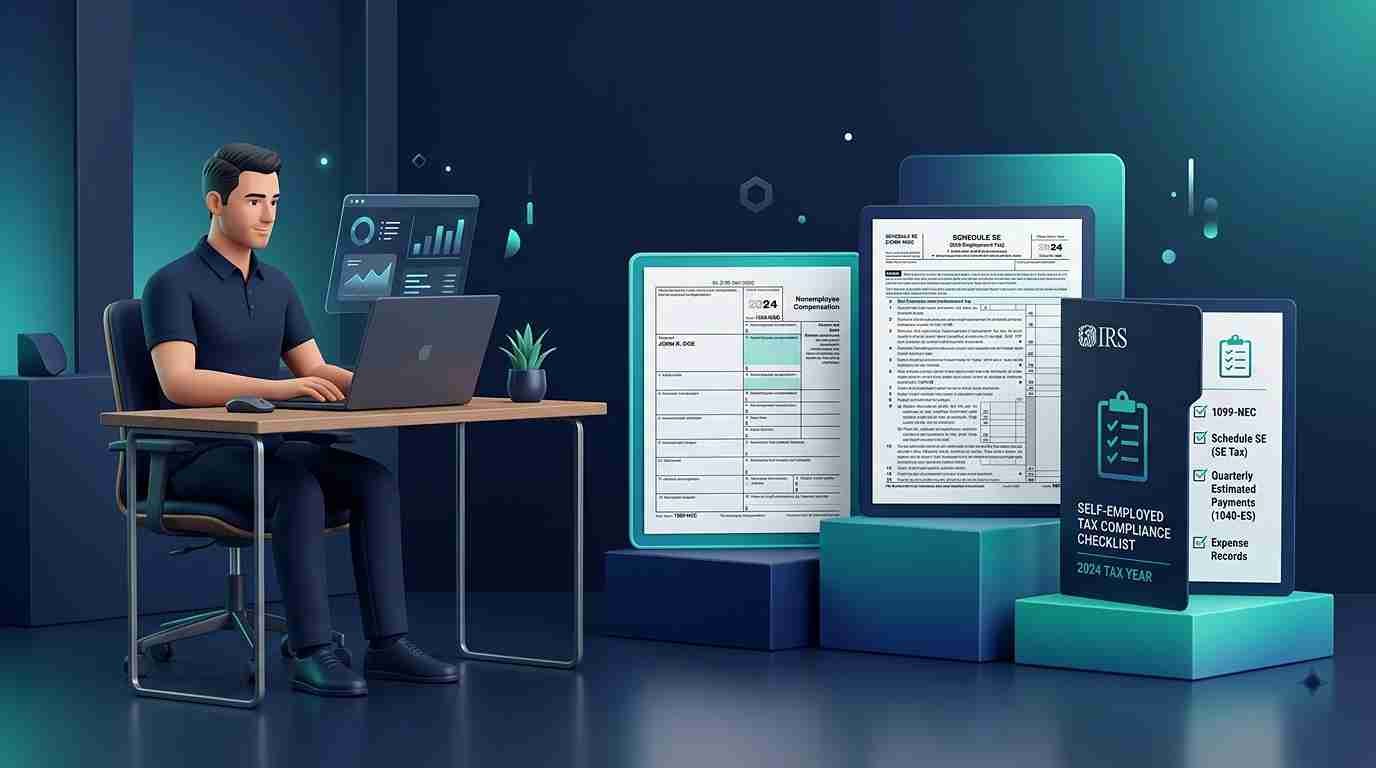
Total tax on $75,000: approximately $17,101 ($10,597 SE tax + $6,504 income tax) — an effective rate of about 22.8%. And remember the filing obligations that go with it: Schedule C to report the business income and expenses, Schedule SE to figure the self-employment tax, Form 1040-ES for the four quarterly estimated payments, and Form 1040 itself. If you need more time to file, request an extension by April 15, 2026 — it moves the filing deadline to October 15, 2026, but it does not extend the time to pay.
Benefits: What 1099 Workers Do and Don’t Get
Self-employed status means no employer benefits package. A 1099 worker generally does not receive:
- Employer health insurance — you buy your own plan. The good news is that self-employed health insurance premiums are generally deductible above the line if you are not eligible for a subsidized plan through a spouse or another job.
- Employer retirement match — there is no 401(k) match, but a Solo 401(k) or SEP IRA lets you save far more per year than an employee deferral alone, and the contributions are tax-deductible.
- Paid vacation, sick leave or holidays — time off is unpaid, and you must price it into your rates.
- Unemployment insurance — independent contractors are generally not covered by state unemployment programs, because no employer paid unemployment tax on their earnings.
- Workers’ compensation — generally not covered; if you are injured on the job, you need your own disability or accident coverage.
None of this means 1099 work is a bad deal — contractors typically charge higher rates precisely because they carry these costs themselves. But if a payer sets your rate as though you were an employee and then classifies you as a contractor, you are absorbing the employer’s costs without the contractor’s premium. That is the arrangement to watch for.
Self-Employed Status and Your Social Security Record
Paying self-employment tax is not money lost: your SE tax is credited toward your Social Security earnings record, which determines your future retirement and disability benefits. A 1099 worker earning $80,000 in net self-employment income earns the same Social Security benefit as a W-2 employee earning the same $80,000 in wages — the difference is that the self-employed worker pays both the employee and employer portions of FICA simultaneously, rather than splitting them with an employer.
State-Level Rules Can Add Costs
Federal classification is only half the picture — state taxes and state classification tests can add significant costs:
- California: a graduated annual LLC fee that starts at $900 for LLCs with total annual income of $250,000 and rises to $11,790 for LLCs with $5 million or more, on top of the state’s $800 annual LLC tax.
- New York City: the Unincorporated Business Tax applies to self-employed individuals operating within the five boroughs.
- Washington: the Business & Occupation (B&O) tax applies to gross receipts, with no deduction for business expenses.
Check your state’s rules before setting your rates — the federal tax bill is not the whole bill.
What If You Were Misclassified? Form SS-8 and Form 8919
If you believe you were treated as an independent contractor but worked as an employee, you have two IRS tools:
1. Form SS-8 — ask the IRS to decide
File Form SS-8, Determination of Worker Status for Purposes of Federal Employment Taxes and Income Tax Withholding, to ask the IRS to determine your status. Either the worker or the business can file it; there is no fee. The form asks detailed questions about control, payment, tools, and the relationship — essentially the three common-law categories above. Both sides get to present their facts, and the IRS issues a determination letter you can rely on when filing. The process can take months, so file it as early as you can.
2. Form 8919 — pay only the employee share while you wait
Workers who believe they were misclassified can file Form 8919, Uncollected Social Security and Medicare Tax on Wages, with their return. Instead of paying the full 15.3% self-employment tax on the misclassified earnings, you pay only the employee’s 7.65% share — the same share a W-2 employee pays — and the employer owes the matching half. To use Form 8919 you must meet one of the form’s reason codes, such as having filed Form SS-8 and received an IRS determination that you are an employee, or having filed Form SS-8 and not yet received a reply. Your Social Security and Medicare taxes are then credited to your Social Security record, which matters for future retirement and disability benefits.
A few practical notes:
- Talk to the payer first. Sometimes misclassification is a mistake, and a corrected W-2 resolves it without any IRS filing.
- Keep records: schedules, messages showing supervision, training materials, equipment lists, and pay records. These are the facts the IRS weighs.
- Misclassification is also a state issue. State labor agencies and unemployment offices apply their own tests (some stricter than the IRS), so a worker can be an employee under state law even while the federal question is pending.
- Do not file Form 8919 just because you would rather have been an employee. You need one of the form’s stated reasons, and the working relationship must actually fit the employee side of the common-law test.
Can a 1099 Worker Ever Be an Employee?
Yes — in two directions. First, a worker can be misclassified, as above: the 1099 says contractor, but the facts say employee, and the IRS (or a state agency) can reclassify the relationship. Second, a worker can hold both statuses at once: employed by one company (W-2) and self-employed on the side (1099). That is common — a teacher who freelances on weekends, or a nurse who picks up independent shifts. Each income stream is taxed by its own rules, on the same return.
There are also narrow exceptions. Certain workers — called statutory employees — receive a W-2 but are treated as self-employed for some purposes, and some corporate officers and other categories have special rules. And state laws can classify a worker as an employee even when the federal common-law test would not; California’s ABC test, for example, is stricter than the IRS test for many state-law purposes. If your situation crosses state lines or involves a state-specific test, that is a question for a local employment attorney or tax professional, not a general guide.
Frequently Asked Questions
Are 1099 employees self-employed for tax purposes?
Usually, yes. The IRS treats a worker who receives Form 1099-NEC as an independent contractor, which means self-employed for tax purposes: Schedule C reporting, 15.3% self-employment tax, and quarterly estimated payments. The exception is misclassification — if the company controlled your work like an employer, you may legally be an employee despite the 1099.
Do 1099 workers pay more tax than W-2 employees?
On the same pay, yes — a 1099 worker pays both halves of Social Security and Medicare (15.3%) while a W-2 employee pays only their half (7.65%) and the employer pays the rest. On $50,000 that is about $3,240 more per year. Contractors offset this with Schedule C deductions and typically higher rates, but the gap is real and should be priced into any 1099 rate.
Can a 1099 worker get health insurance or a 401(k)?
Yes, but you arrange and fund them yourself. Self-employed health insurance premiums are generally deductible, and a Solo 401(k) or SEP IRA allows large tax-deductible contributions. What you do not get is an employer paying part of the premium or matching your retirement contributions.
What is the difference between a 1099 worker and a subcontractor?
There is no tax difference — “subcontractor” is just the word businesses often use for an independent contractor they hire for a specific job. A 1099 worker, an independent contractor and a subcontractor are all self-employed for tax purposes, as opposed to an employee on a W-2.
I got a 1099 but my boss treats me like an employee. What should I do?
First, raise it with the payer — it may be a fixable mistake. If that fails, file Form SS-8 to ask the IRS to determine your worker status, and consider filing Form 8919 with your return so you pay only the 7.65% employee share of Social Security and Medicare tax on those earnings instead of the full 15.3% self-employment tax. Keep records of schedules, instructions and supervision to support your claim.
Can I be a full-time 1099 worker for a single client?
Yes — but this scenario carries serious misclassification risk. Working full-time hours exclusively for a single client does not automatically eliminate self-employment; the IRS looks at the arrangement under the common-law control test — specifically whether the business controls how, when, and where the work is performed. If you work full-time for one client, protect yourself with a well-drafted independent contractor agreement, set your own hours where you can, and diversify your income sources over time.
Does forming an LLC change my 1099 status?
No — operating under an LLC does not change the fundamental self-employment analysis. A single-member LLC is a disregarded entity for federal tax purposes, so the SE tax applies, Schedule C applies, and quarterly estimated payments apply. The LLC provides liability protection, not a different tax classification — although electing corporate treatment with Form 2553 or Form 8832 can change how the business is taxed, which is a separate decision to make with a tax professional.
Can I get state unemployment benefits if I was misclassified?
Not necessarily — and this is where state law can differ sharply from federal law. Several states apply significantly stricter worker classification standards than the federal common-law test: California’s ABC Test presumes every worker is an employee unless the hiring business proves otherwise, and New York and New Jersey apply similar expanded classification frameworks. Confirming self-employed status for federal income tax purposes does not automatically resolve your state unemployment eligibility — if you believe you were misclassified, file a claim with your state unemployment agency.
Last reviewed: November 23, 2026. This article is general information, not tax advice. Worker classification depends on the facts of each relationship; confirm your situation on IRS.gov or with a qualified tax professional before filing.
Sources: IRS — Independent Contractor (Self-Employed) or Employee?: https://www.irs.gov/businesses/small-businesses-self-employed/independent-contractor-self-employed-or-employee | IRS Topic No. 762 — Independent Contractor vs. Employee: https://www.irs.gov/taxtopics/tc762 | IRS Topic No. 554 — Self-Employment Tax: https://www.irs.gov/taxtopics/tc554 | IRS Schedule SE (Form 1040), 2026: https://www.irs.gov/pub/irs-pdf/f1040sse.pdf | IRS — Misclassified Workers to File New Social Security Tax Form: https://www.irs.gov/newsroom/misclassified-workers-to-file-new-social-security-tax-form | IRS Revenue Procedure 2025-32 — 2026 standard deduction and brackets: https://www.irs.gov/pub/irs-drop/rp-25-32.pdf