Will 1099 affect my taxes? Yes — receiving a 1099 affects your taxes, and usually by more than new contractors expect. A 1099 means no employer withheld tax from your pay, so you owe both income tax on your net profit and the 15.3% self-employment tax, and you must pay it yourself in quarterly estimated payments. On $60,000 of net self-employment profit, that combined federal bill is roughly $12,989 before any state tax. This guide walks through exactly how 1099 income is reported, how the tax is calculated step by step, what deductions reduce it, and how it compares with a W-2 paycheck — with 2026 figures verified against IRS guidance.
Quick Reference Compliance Matrix
| Tax Obligation | Will 1099 Affect My Taxes Here | 2026 Rate / Threshold | IRS Authority |
|---|---|---|---|
| Self-Employment Tax — Social Security | Yes — 12.4% on 92.35% net income | Up to $184,500 wage base | IRC § 1401(a) |
| Self-Employment Tax — Medicare | Yes — 2.9% on 92.35% net income | No upper income limit | IRC § 1401(b) |
| Additional Medicare Tax | Yes — 0.9% above $200,000 | Single filer threshold | IRC § 1401(b)(2) |
| Federal Income Tax | Yes — marginal bracket rate | 10% to 37% in 2026 | IRC § 1 |
| Quarterly Estimated Payments | Yes — mandatory above $1,000 liability | 4 deadlines annually | IRC § 6654 |
| State Income Tax | Yes — varies by state | 0% to 13.3% | State authority |
| SE Tax Deduction | Reduces — 50% of SE tax deductible | Above-the-line deduction | IRC § 164(f) |
| Schedule C Deductions | Reduces — all ordinary business expenses | Dollar-for-dollar reduction | IRC § 162 |
How 1099 Income Is Reported to the IRS
A Form 1099 is an information return, not a tax bill. The payer — the business or client who paid you — sends one copy to you and one copy to the IRS, so the IRS already knows what you were paid before you file. Your job is to report that income on your own return and pay the tax on it.
For most freelancers and independent contractors, the reporting chain looks like this:
- Form 1099-NEC reports nonemployee compensation — the money a business paid you for services. A payer must file it when total payments to you reach the reporting threshold: $600 for payments made in 2025, and $2,000 for payments made in 2026 under the One Big Beautiful Bill Act.
- Schedule C (Form 1040) is where you report the gross 1099 income and subtract your ordinary and necessary business expenses. The result is your net profit — the number your tax is actually calculated on.
- Schedule SE (Form 1040) calculates your self-employment tax on that net profit.
- Form 1040 pulls it all together: net profit, the deductible half of self-employment tax, your standard or itemized deduction, and your final income tax.
Two points catch people out. First, you must report all of your self-employment income even if you never receive a 1099 — for example, if a client paid you less than the reporting threshold, or paid you through a payment app. The 1099 is the payer’s reporting duty, not the limit of your income. Second, the IRS matches the 1099s it receives against your return automatically. If a 1099 shows income you did not report, the mismatch can trigger a CP2000 notice proposing additional tax.
Other 1099 forms cover different income: Form 1099-MISC for rents, prizes and other miscellaneous payments, and Form 1099-K for payment-card and third-party network transactions (the threshold for 2026 is $20,000 and more than 200 transactions). Whichever form arrives, the principle is the same — the income is taxable, and no tax was withheld from it.
The Self-Employment Tax: The Biggest Surprise for New 1099 Workers
Most new contractors ask will 1099 affect my taxes expecting the answer to involve income tax brackets. The real shock is the self-employment tax — and it hits before income tax even enters the picture.
A W-2 employee pays 7.65% of wages in FICA taxes (6.2% Social Security + 1.45% Medicare), and their employer quietly pays a matching 7.65% on top. As a 1099 contractor, there is no employer — so you pay both halves yourself: 15.3% in total, made up of 12.4% for Social Security and 2.9% for Medicare, as set out in IRS Topic No. 554.
| Part of self-employment tax | Rate | Applies to |
|---|---|---|
| Social Security | 12.4% | 92.35% of net earnings, up to the $184,500 wage base for 2026 |
| Medicare | 2.9% | 92.35% of net earnings, with no upper limit |
| Combined | 15.3% | 92.35% of net earnings from self-employment |
Three details matter:
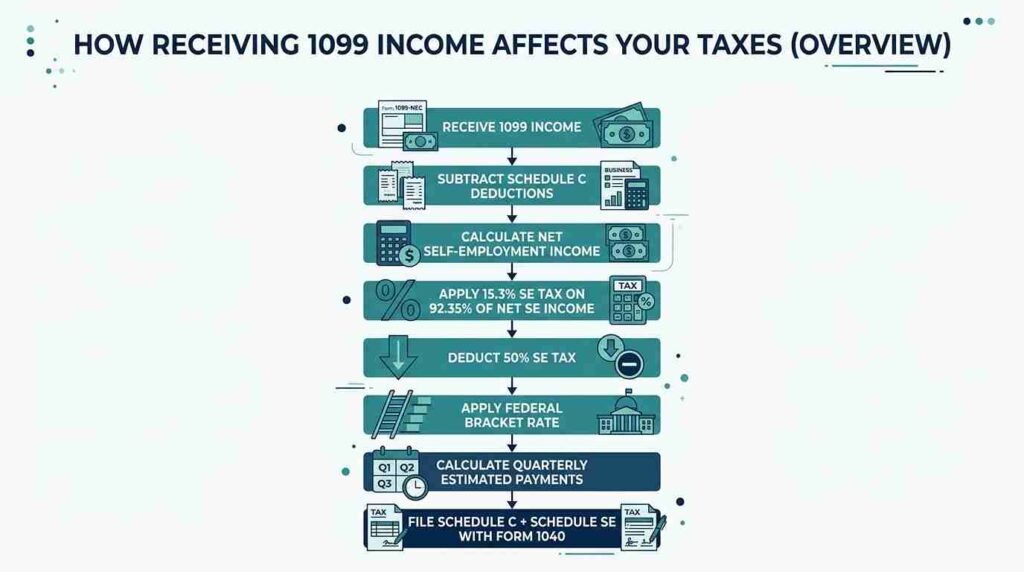
- The 92.35% factor. Self-employment tax is not charged on your full net profit. Schedule SE multiplies net earnings by 92.35% first — the equivalent of removing the employer half before taxing — and then applies the 15.3% rate.
- The $400 threshold. You generally must pay self-employment tax if your net earnings from self-employment are $400 or more for the year. Below that, no self-employment tax is due — although the income itself is still reportable.
- The Social Security wage base. For 2026, the 12.4% Social Security portion applies only to the first $184,500 of combined wages and net earnings. The 2.9% Medicare portion has no cap. High earners also owe the 0.9% Additional Medicare Tax on earnings above $200,000 (single filer) or $250,000 (married filing jointly), reported on Form 8959.
There is one real offset: you may deduct one-half of your self-employment tax when figuring adjusted gross income (Schedule 1, Form 1040). It lowers your income tax, but it does not reduce the self-employment tax itself.
Worked Example: $70,000 of 1099 Income in 2026
Here is the full calculation for a single filer with $70,000 of gross 1099 income and $10,000 of Schedule C business deductions. Every figure below follows the IRS forms in order.
| Step | Calculation | Amount |
|---|---|---|
| Gross 1099 income | — | $70,000 |
| Less Schedule C deductions | — | − $10,000 |
| Net profit (Schedule C) | — | $60,000 |
| Net earnings subject to SE tax | $60,000 × 92.35% | $55,410 |
| Social Security portion | $55,410 × 12.4% | $6,871 |
| Medicare portion | $55,410 × 2.9% | $1,607 |
| Self-employment tax (Schedule SE) | — | $8,478 |
| Less one-half of SE tax | $8,478 × 50% | − $4,239 |
| Adjusted gross income | $60,000 − $4,239 | $55,761 |
| Less 2026 standard deduction (single) | — | − $16,100 |
| Taxable income | — | $39,661 |
| Federal income tax | 10% × $12,400 + 12% × $27,261 | $4,511 |
| Total federal tax | $8,478 + $4,511 | $12,989 |
That is about 21.6% of the $60,000 net profit in federal tax — before any state income tax. Notice where the money goes: the $8,478 self-employment tax is nearly double the $4,511 income tax. That is why the SE tax, not the bracket rate, is the shock for most first-year contractors. And notice what drives the result: every dollar of legitimate Schedule C deduction cuts both the SE tax and the income tax at once.
Federal Income Tax Brackets for 2026
Federal income tax is the second layer in the will 1099 affect my taxes calculation — and unlike the flat SE tax rate, it scales with your income through progressive brackets. The rates are 10%, 12%, 22%, 24%, 32%, 35% and 37%, and each rate applies only to the slice of taxable income inside that bracket, not to your whole income.
2026 federal tax brackets, single filers (IRS Revenue Procedure 2025-32):
| Rate | Taxable income (single) |
|---|---|
| 10% | $0 – $12,400 |
| 12% | $12,401 – $50,400 |
| 22% | $50,401 – $105,700 |
| 24% | $105,701 – $201,775 |
| 32% | $201,776 – $256,225 |
| 35% | $256,226 – $640,600 |
| 37% | Over $640,600 |
Your 1099 income does not enter the brackets at the gross level. The correct sequence is: gross 1099 income, minus Schedule C deductions, minus one-half of self-employment tax, minus the standard deduction — $16,100 for single filers and $32,200 for married couples filing jointly in 2026. Only the figure left after all of that is your taxable income, and that is what the bracket rates apply to. In the worked example above, $70,000 of gross income became $39,661 of taxable income, taxed at 10% and 12% only — the contractor never touched the 22% bracket.
How Will 1099 Affect My Taxes Compared to a W-2 Salary?
This is the comparison that matters most for contractors weighing whether 1099 work pays — and the numbers are more nuanced than most people expect.
| — | W-2 employee, $70,000 salary | 1099 contractor, $70,000 gross / $10,000 deductions |
|---|---|---|
| Payroll / SE tax | $5,355 employee FICA (7.65%) | $8,478 SE tax (15.3% of 92.35% of net) |
| Taxable income | $53,900 | $39,661 |
| Federal income tax | $6,570 | $4,511 |
| Total federal tax | $11,925 | $12,989 |
| Withholding | Automatic, every paycheck | None — you pay quarterly yourself |
| Business deductions | Generally none available | Schedule C: home office, mileage, equipment, health insurance |
| Benefits | Employer health plan, 401(k) match, paid leave | None from the payer — you fund your own |
In this example the contractor pays about $1,064 more in federal tax than the W-2 employee on the same $70,000 — the extra employer half of FICA, partly offset by lower taxable income from deductions. But the gap moves fast with deductions: a contractor who legitimately claims $15,000 of Schedule C deductions instead of $10,000 cuts both SE tax and income tax, and the comparison can flip. The honest answer to will 1099 affect my taxes more than W-2 work is: yes, before deductions — and the size of the gap is largely decided by how well you track deductible business expenses.
Quarterly Estimated Payments: The Timing Trap
The answer to will 1099 affect my taxes is not just about how much — it is also about when the IRS expects to be paid. W-2 employees pay continuously through payroll withholding. 1099 contractors pay four times a year through estimated tax payments (Form 1040-ES), and the IRS can charge an underpayment penalty if you pay too little, too late.
2026 quarterly estimated tax due dates:
| Quarter | Income period | Due date |
|---|---|---|
| Q1 | January 1 – March 31, 2026 | April 15, 2026 |
| Q2 | April 1 – May 31, 2026 | June 15, 2026 |
| Q3 | June 1 – August 31, 2026 | September 15, 2026 |
| Q4 | September 1 – December 31, 2026 | January 15, 2027 |
You generally must pay estimated tax if you expect to owe $1,000 or more in total tax for the year after withholding and refundable credits. The safest route for most contractors is the prior-year safe harbor: pay 100% of last year’s total tax liability in four equal installments (110% if your prior-year adjusted gross income was over $150,000). Meeting the safe harbor eliminates the underpayment penalty even if your current-year income jumps. Alternatively, pay at least 90% of the current year’s expected tax. Pay with IRS Direct Pay or EFTPS — both are free and give immediate confirmation. Keep the confirmation for your records.
Deductions That Reduce How Much a 1099 Affects Your Taxes
Deductions are the contractor’s main lever, because they reduce the net profit that both the SE tax and the income tax are calculated on. Common Schedule C deductions include:
- Home office — the simplified option or actual expenses for a space used regularly and exclusively for business.
- Vehicle mileage — business miles at the IRS standard mileage rate, or actual vehicle expenses; keep a mileage log.
- Equipment, software and supplies — computers, tools, subscriptions and materials used for the work.
- Phone and internet — the business-use share of your bills.
- Self-employed health insurance premiums — generally deductible above the line if you are not eligible for a subsidized plan elsewhere.
- Retirement contributions — a SEP IRA or Solo 401(k) can shelter a large share of profit; contribution limits change annually, so check the current IRS limits before contributing.
- Qualified business income (QBI) deduction — many sole proprietors may deduct up to 20% of qualified business income, subject to IRS limits and thresholds.
The rule for every deduction is the same: the expense must be ordinary and necessary for your trade or business, and you must be able to prove it with records. A separate business bank account and a habit of photographing receipts will save you more at tax time than any single deduction.
How 1099 Income Interacts With W-2 Income on the Same Return
Many contractors ask will 1099 affect my taxes while also holding a W-2 job — and this combination creates a specific problem. Your W-2 employer withholds tax based only on your salary. They have no visibility into your 1099 side income, so your withholding is almost always too low for your combined liability. Two fixes work:
- Increase W-2 withholding with a new Form W-4 — add an extra dollar amount to withhold per pay period. This uses your payroll system to collect tax on the 1099 income automatically, and withholding is treated as paid evenly through the year, which can help with underpayment penalties.
- Pay quarterly estimates on the 1099 income only, leaving W-2 withholding unchanged.
One more interaction matters: W-2 wages count toward the $184,500 Social Security wage base first. If your W-2 wages already reach the wage base, your self-employment earnings above that point are subject only to the 2.9% Medicare portion of SE tax, not the 12.4% Social Security portion. Schedule SE handles this automatically — but it is a reason to file Schedule SE carefully rather than estimating SE tax by hand.
State Tax: The Third Layer
Will 1099 affect my taxes at the state level depends entirely on where you live — and the variation is enormous.
Nine states — Alaska, Florida, Nevada, New Hampshire, South Dakota, Tennessee, Texas, Washington and Wyoming — levy no broad-based individual income tax on earnings, so contractors there face only the federal layers described above. (Washington does tax some large long-term capital gains, but not wage or self-employment income.)
At the other end, California taxes self-employment profit as ordinary income at rates from 1% to 12.3%, plus a 1% Mental Health Services Tax on taxable income over $1 million — a top rate of 13.3%. California does not impose its own separate self-employment tax. The 15.3% self-employment tax is federal only; California simply taxes your net profit through its regular income tax, starting from federal adjusted gross income. California also has its own estimated-payment schedule on Form 540-ES — front-loaded at 30% by April 15, 40% by June 15, 0% in September and 30% in January — and you generally must pay if you expect to owe $500 or more in state tax ($250 if married filing separately). New York, Oregon and New Jersey are also high-burden states for 1099 workers, and all require separate state estimated payments.
If you live in one state and work for clients in another, check both states’ rules — some states tax income earned within their borders regardless of where you live.
Will a 1099 Mean a Refund or a Bill?
A 1099 by itself does not decide whether you get a refund or owe money — your total withholding and estimated payments for the year decide that. Because nothing is withheld from 1099 pay, contractors who skip estimated payments usually owe a balance in April, plus a possible underpayment penalty. Contractors who pay quarterly, or who have W-2 withholding covering the 1099 income, often end up close to even or with a small refund. If you owed a large balance this year, the fix is not a different form — it is a bigger quarterly payment or a higher W-4 withholding amount next year.
What to Do If Your 1099 Is Wrong
The IRS receives a copy of every 1099 issued to you, so an error on the form can become your problem. If a client reports the wrong amount, contact them immediately and request a corrected 1099 before you file. If a correction is not possible before the filing deadline, report the income you actually received on Schedule C and keep records — payment records, invoices and bank deposits — that support your figure. Do not simply report an overstated 1099 amount; that is paying tax you do not owe. If the IRS’s matching system flags a discrepancy, it usually arrives as a CP2000 notice proposing additional tax — respond to it with your documentation rather than ignoring it.
Frequently Asked Questions
Will 1099 affect my taxes if I also received W-2 income in the same year?
Yes. Your W-2 employer withholds tax based only on your salary and cannot see your 1099 income, so your combined withholding is almost always too low. Either raise your W-4 withholding at the W-2 job or make quarterly estimated payments on the 1099 income. If you underpay through the year, underpayment penalties can apply regardless of which income caused the shortfall.
Will 1099 affect my taxes more if I receive multiple 1099 forms from different clients?
Not in the way most contractors fear. The IRS does not tax each 1099 separately. All 1099 income from every client is combined on a single Schedule C, reduced by your total business deductions, and the resulting net profit determines your tax. Five 1099s totalling $80,000 produce the same tax as one 1099 for $80,000. The only added complication is bookkeeping across multiple clients.
Will 1099 affect my taxes if the amount reported on the form is incorrect?
Yes — and act quickly. Ask the payer for a corrected 1099 before you file. If that is not possible, report the income you actually received on Schedule C and keep invoices, payment records and bank statements to support it. An uncorrected mismatch can trigger a CP2000 notice from the IRS’s automated matching system.
Do I owe self-employment tax on 1099 income under $400?
Generally no — self-employment tax applies when net earnings from self-employment are $400 or more. But the income itself is still taxable and must be reported on your return. And the $400 test applies to net earnings (profit after expenses), not gross payments.
Can I get a refund with 1099 income?
Yes. A refund depends on whether your total payments for the year — withholding plus estimated payments plus refundable credits — exceed your total tax. Many contractors who pay quarterly estimates, or whose W-2 withholding covers their side income, receive refunds. A 1099 alone does not mean you will owe.
Last reviewed: November 23, 2026. This article is general information, not tax advice. Tax law and IRS figures change; confirm current amounts on IRS.gov or with a qualified tax professional before filing.
Sources: IRS Topic No. 554 — Self-Employment Tax: https://www.irs.gov/taxtopics/tc554 | IRS Schedule SE (Form 1040), 2026: https://www.irs.gov/pub/irs-pdf/f1040sse.pdf | IRS — Independent Contractor (Self-Employed) or Employee?: https://www.irs.gov/businesses/small-businesses-self-employed/independent-contractor-self-employed-or-employee | IRS Topic No. 762 — Independent Contractor vs. Employee: https://www.irs.gov/taxtopics/tc762 | IRS — Payroll Taxes and Federal Income Tax Withholding: https://apps.irs.gov/app/understandingTaxes/hows/tax_tutorials/mod14/tt_mod14_08.jsp | IRS Revenue Procedure 2025-32 — 2026 tax brackets and standard deduction: https://www.irs.gov/pub/irs-drop/rp-25-32.pdf