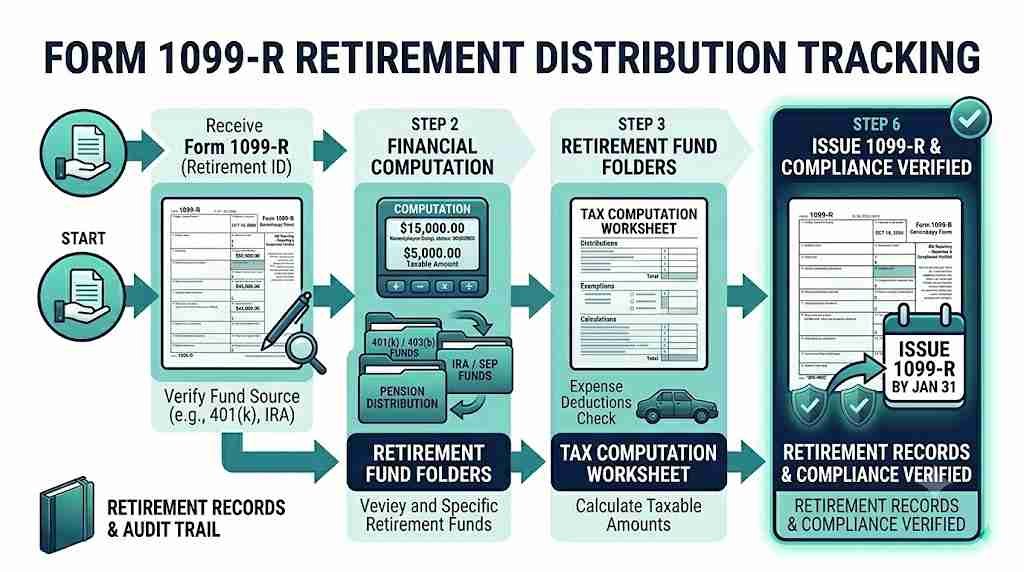
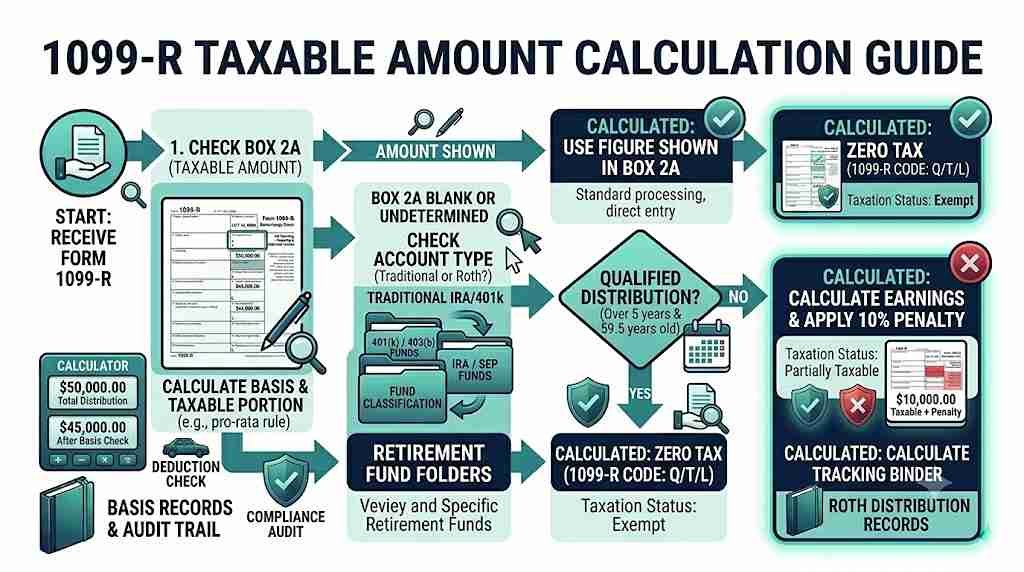
Start with Box 2a on your Form 1099-R — that is the taxable amount. If Box 2a has a number, use it on your tax return. If Box 2a is blank and the first box in Box 2b (“taxable amount not determined”) is checked, the payer could not figure the taxable amount, and you must calculate it yourself. For most people with a pension or annuity from a qualified employer plan, that means the IRS Simplified Method: divide your after-tax cost (your “basis”) by the number of expected monthly payments from the IRS table, and that gives you the tax-free part of each monthly payment. Everything else in the payment is taxable.
Form 1099-R reports distributions from pensions, annuities, retirement plans, and IRAs. The gross distribution in Box 1 is rarely the same as the taxable amount, because part of what you received may be a return of money you already paid tax on, a rollover that is not taxable at all, or a qualified Roth distribution. If you are still waiting for yours, see when your 1099-R arrives and what to do if it is late. This guide walks through the form box by box, explains the Simplified Method step by step with a full worked example, and covers the General Rule, Roth rules, rollovers, and the 10% additional tax on early distributions.
Statutory Compliance Requirements for Businesses
The governing statutory framework for how do i calculate taxable amount on 1099-r spans multiple IRC provisions. IRC § 72 governs the taxation of annuities and pension distributions. IRC § 408 governs traditional IRA distributions. IRC § 408A governs Roth IRA qualified distributions. IRC § 402 governs employer-sponsored retirement plan distributions including 401(k) and 403(b) accounts.
Each provision establishes a distinct taxability framework — meaning the identical gross distribution amount can produce dramatically different taxable amounts depending solely on which account type generated the distribution and whether after-tax contributions were previously made.
The IRS requires payers to complete Box 2a of Form 1099-R with the taxable amount when it can be determined. When Box 2a is left blank or shows zero with Box 2b checked as “Taxable amount not determined” — the full burden of calculating the correct taxable amount shifts entirely to the recipient taxpayer.
For the complete official IRS guidance on retirement distribution taxation and 1099-R calculation methods, refer to the IRS Publication 575 — Pension and Annuity Income.
Understanding how do i calculate taxable amount on 1099-r correctly also connects directly to your broader retirement income tax strategy. Knowing how much to set aside for taxes as a 1099 contractor ensures your quarterly estimated tax payments adequately cover retirement distribution tax liability alongside any self-employment income received during the same calendar year.
It is equally important to understand whether a 1099 will affect your overall tax liability when retirement distributions combine with other income sources — since the interaction between 1099-R income and W-2 wages, Social Security benefits, and self-employment income can significantly alter your effective tax rate and standard deduction optimization strategy.
Quick Reference Compliance Matrix
| Distribution Source | Taxable Amount Calculation Method | IRS Authority | Key Form |
|---|---|---|---|
| Traditional IRA | 100% of gross distribution | IRC § 408(d)(1) | Form 1040, Line 4b |
| Traditional IRA with basis | Pro-rata calculation using Form 8606 | IRC § 408(d)(1) | Form 8606 |
| Roth IRA qualified | $0 taxable | IRC § 408A(d)(1) | Form 1040, Line 4b |
| Roth IRA non-qualified | Earnings taxable; contributions tax-free | IRC § 408A(d)(2) | Form 8606 |
| 401(k) pre-tax | 100% of gross distribution | IRC § 402(a) | Form 1040, Line 5b |
| 401(k) after-tax | Pro-rata based on investment in contract | IRC § 72(e) | Form 1040, Line 5b |
| Pension | Simplified Method calculation | IRC § 72(d) | Form 1040, Line 5b |
| Annuity | General Rule exclusion ratio | IRC § 72 | Form 1040, Line 5b |
| Early distribution | 10% additional tax on taxable amount | IRC § 72(t) | Form 5329 |
| Disability | Same as underlying distribution type | IRC § 72(m)(7) | Form 5329 |
First, Read the Right Boxes on Your 1099-R
Before any calculation, make sure you are reading the form correctly. These are the boxes that decide your taxable amount:
| Box | What it shows | What it means for you |
|---|---|---|
| Box 1 — Gross distribution | The total amount paid to you before any withholding or other reduction. | This is a gross movement figure, not an income figure. It includes money that was rolled over and money that is a return of your after-tax contributions. |
| Box 2a — Taxable amount | The part of the distribution that is taxable. | If a number is printed here, report it. If it is blank, you must figure the taxable amount yourself. |
| Box 2b — Taxable amount not determined / Total distribution | Two checkboxes. The first means the payer could not determine the taxable amount; the second means the distribution closed out your account. | A checked first box plus a blank Box 2a is your signal to do the calculation yourself. |
| Box 4 — Federal income tax withheld | Tax the payer already sent to the IRS for you. | This is a payment, not income. It goes on your return as tax withheld. |
| Box 5 — Employee contributions / Designated Roth contributions or insurance premiums | Your after-tax contributions recovered tax free this year (and related amounts). | Explains part of any difference between Box 1 and Box 2a. |
| Box 6 — Net unrealized appreciation in employer’s securities | Applies to lump-sum distributions of employer stock. | Generally not taxed until you sell the shares. |
| Box 7 — Distribution code(s) | Codes describing the type of distribution (for example, 1 = early distribution, 7 = normal distribution, G = direct rollover). | A wrong code can cause the wrong tax treatment — check it against what actually happened. |
| Box 9b — Total employee contributions | Your total after-tax contributions to the plan. | This is the starting point for your “cost” (basis) in the Simplified Method. |
If Box 1 and Box 2a are the same number, the whole distribution is taxable (assuming the form is correct). If Box 2a is smaller than Box 1, the difference is generally a return of your after-tax contributions, a rollover amount, or another nontaxable portion — and the difference should be explained by Box 5 or the distribution code in Box 7.
When You Can Trust Box 2a — and When You Cannot
In most cases, the payer knows your contribution history and prints the correct taxable amount in Box 2a. Trust it when the distribution is straightforward — for example, a distribution entirely from pre-tax 401(k) money, where the whole amount is taxable and Box 2a equals Box 1.
Do not trust Box 2a blindly if any of the following apply:
- Box 2a is blank and the first box in Box 2b is checked. The payer is telling you it does not have enough information to determine the taxable amount. The calculation is your responsibility.
- You made after-tax contributions and Box 2a equals Box 1 anyway. Part of each payment should be a tax-free return of your contributions.
- Box 7 shows a rollover code (G) but Box 2a shows a taxable amount. A direct rollover should generally show zero as the taxable amount.
- You received a lump-sum distribution of employer stock with net unrealized appreciation in Box 6. Special rules apply.
- The form is marked CORRECTED and the new figures differ from the original. Always use the corrected form.
Per the instructions printed on the back of Form 1099-R, if your annuity starting date is after 1997 and the payer did not show the taxable amount in Box 2a, you must use the Simplified Method to figure your taxable amount. The next sections explain exactly how.
What “Basis” (Cost) Means
The key idea behind the whole calculation is simple: you should not pay tax twice on the same money. Your cost, also called your basis or investment in the contract, is the total amount of after-tax money you put into the plan — contributions you already paid tax on, plus certain other amounts such as any death benefit exclusion that applies. Money your employer contributed pre-tax, and all the earnings inside the plan, are not part of your cost. They are taxable when distributed.
Where to find your cost:
- Box 9b of Form 1099-R shows your total employee contributions. For many people this is the cost figure.
- Your plan administrator can confirm the cost if Box 9b is blank or if you are unsure — especially if you made after-tax contributions over many years or rolled money between plans.
- Your own records — old pay stubs showing after-tax pension contributions, and prior-year tax returns — are the fallback if the plan’s records are incomplete.
One hard limit applies: if your annuity starting date is after 1986, the total amount you can exclude from income over the years as a recovery of your cost cannot exceed your total cost. Once you have recovered your full cost tax free, later payments are generally fully taxable. If you die before recovering your full cost, the unrecovered amount is allowed as an itemized deduction on the final return of the last annuitant to die.
The Simplified Method: Step by Step
Under the Simplified Method, you figure the tax-free part of each annuity payment by dividing your cost by the total number of expected monthly payments. That number comes from an IRS table based on your age (or the combined ages, for a joint and survivor annuity) on your annuity starting date.
Who must use the Simplified Method?
You must use the Simplified Method if your annuity starting date is after November 18, 1996, and both of these conditions are met:
- Your payments come from a qualified employee plan, a qualified employee annuity, or a 403(b) tax-sheltered annuity plan; and
- On your annuity starting date, you were under age 75, or you were entitled to less than 5 years of guaranteed payments.
You cannot use the Simplified Method if your payments come from a nonqualified plan, such as a private or commercial annuity you bought yourself. In that case, use the General Rule instead (see below). You determine which method to use when you first begin receiving your annuity, and you continue using it each year while you recover your cost.
The IRS expected-payments tables (Worksheet A, Publication 575)
These are the exact figures from the Simplified Method Worksheet in IRS Publication 575. Use the column for your annuity starting date. For annuities starting after November 18, 1996 — which covers nearly everyone retiring today — use the right-hand column of Table 1.
Table 1 — Single-life annuity (annuity payable over your life only)
| Your age at the annuity starting date | Expected monthly payments — starting date BEFORE Nov 19, 1996 | Expected monthly payments — starting date AFTER Nov 18, 1996 |
|---|---|---|
| 55 or under | 300 | 360 |
| 56–60 | 260 | 310 |
| 61–65 | 240 | 260 |
| 66–70 | 170 | 210 |
| 71 or older | 120 | 160 |
Table 2 — Joint and survivor annuity (annuity starting date after 1997; use the annuitants’ combined ages)
| Combined ages at the annuity starting date | Expected monthly payments |
|---|---|
| 110 or under | 410 |
| 111–120 | 360 |
| 121–130 | 310 |
| 131–140 | 260 |
| 141 or older | 210 |
Important correction — read this carefully: age 55 belongs in the “55 or under” row at 360 expected payments, not in the 56–60 row. The 56–60 row is 310 payments. Grouping age 55 with ages 56–60 at 310 payments is wrong — it understates your expected payments, overstates the tax-free part of each payment, and understates your taxable amount. If you are 55 when your annuity starts, divide your cost by 360. If you are 56, 57, 58, 59, or 60, divide by 310. The same boundary logic applies at every row: the age ranges are 55 or under, 56–60, 61–65, 66–70, and 71 or older.
For a fixed-period annuity — one that does not depend on anyone’s life expectancy — the number of expected payments is simply the number of monthly payments under the contract. For an annuity starting before 1998 that is payable over more than one life, do not use Table 2; use Table 1 with the primary annuitant’s age instead.
The calculation, in four steps
- Line 1: Enter the total pension or annuity payments you received this year.
- Line 2: Enter your cost in the plan at the annuity starting date.
- Line 3: Enter the number of expected monthly payments from Table 1 or Table 2 above.
- Line 4: Divide line 2 by line 3. This is the tax-free amount of each monthly payment. Multiply it by the number of months you received payments this year, subtract that total from line 1, and the result is your taxable amount for the year.
Keep your completed worksheet. Next year, you can skip line 3 and reuse the line 4 amount from last year’s worksheet — the monthly tax-free amount stays the same until your cost is fully recovered.
Worked Example: The Full Simplified Method Calculation
The IRS illustrates the Simplified Method in Publication 575 with an example. Here it is, worked through in full, followed by a second example for a single-life annuity.
Example 1 — The IRS example (joint and survivor annuity)
Bill Smith, age 65, began receiving retirement benefits in 2025 under a joint and survivor annuity. His annuity starting date is January 1, 2025. The benefits are payable for the joint lives of Bill and his spouse, age 65. Bill contributed $31,000 to a qualified plan and received no distributions before the annuity starting date. He receives $1,200 a month; his spouse would receive a $600 monthly survivor benefit after Bill’s death.
| Worksheet A line | Figure | How it is figured |
|---|---|---|
| 1. Total payments received this year | $14,400 | $1,200 × 12 months |
| 2. Cost in the plan | $31,000 | Bill’s after-tax contributions |
| 3. Expected monthly payments | 310 | Table 2: combined ages 65 + 65 = 130, which falls in the 121–130 row |
| 4. Tax-free amount per month | $100 | $31,000 ÷ 310 |
| 5. Tax-free amount for the year | $1,200 | $100 × 12 months |
| 9. Taxable amount for the year | $13,200 | $14,400 − $1,200 (enter on Form 1040, line 5b) |
| 11. Balance of cost to be recovered | $29,800 | $31,000 − $1,200 |
Two points from this example matter for everyone. First, after Bill’s death, if he has not recovered the full $31,000, his spouse excludes the same $100 from each $600 survivor payment. Second, after 310 payments have been made, the full amount of every later payment is included in gross income — the tax-free portion ends when the expected number of payments is reached or the cost is fully recovered, whichever comes first.
Example 2 — Single-life annuity, age 58
Suppose Maria, age 58, retires and begins a single-life annuity from her employer’s qualified plan on March 1, 2026. Her cost (after-tax contributions) is $36,000, and she receives $1,500 a month. She receives payments for 10 months in 2026.
- Expected payments (Table 1): Maria is 58, so she falls in the 56–60 row — 310 expected monthly payments. (If she were 55, the figure would be 360.)
- Tax-free amount per month: $36,000 ÷ 310 = $116.13.
- Total payments received in 2026: $1,500 × 10 = $15,000. This is her Box 1 gross distribution and goes on Form 1040, line 5a.
- Tax-free amount for 2026: $116.13 × 10 = $1,161.30.
- Taxable amount for 2026: $15,000 − $1,161.30 = $13,838.70. This goes on Form 1040, line 5b.
- Cost still to recover: $36,000 − $1,161.30 = $34,838.70. Maria will keep excluding $116.13 a month in future years until that balance reaches zero.
If Maria’s payer had already printed a taxable amount in Box 2a, she would compare it with her own figure. If her worksheet shows a smaller taxable amount than the form, the IRS instructions say to use the amount figured on the worksheet instead.
The General Rule: When the Simplified Method Does Not Apply
Under the General Rule, you figure the tax-free part of each annuity payment from the ratio of your cost to your total expected return, using life-expectancy (actuarial) tables prescribed by the IRS. You must use the General Rule if you receive payments from a nonqualified plan — such as a private annuity, a purchased commercial annuity, or a nonqualified employee plan — or from a qualified plan if you are age 75 or older on your annuity starting date and your annuity payments are guaranteed for at least 5 years. For a qualified plan with an annuity starting date before November 19, 1996, you generally could have chosen either method.
The General Rule is more complex than the Simplified Method because the expected return depends on actuarial tables rather than a single fixed number of payments. Full instructions, including the tables, are in IRS Publication 939, General Rule for Pensions and Annuities. If your situation falls under the General Rule and the payer did not figure the taxable amount for you, consider getting help from a tax professional rather than working from the tables yourself.
Nonperiodic Distributions and Lump Sums
Not every distribution is a monthly annuity payment. Cash withdrawals, lump-sum distributions, and certain loans are nonperiodic distributions, and the taxable amount is figured differently. In general, for a nonperiodic distribution from a qualified plan, the taxable amount is the distribution minus your cost allocated to it — but the allocation rules depend on whether the distribution was made before or after the annuity starting date and whether the plan is qualified or nonqualified. Lump-sum distributions from a pension, stock bonus, or profit-sharing plan may also qualify for special treatment, including the 10-year tax option or capital gain treatment, figured on Form 4972. If you received a lump sum, check Box 3 (capital gain) and Box 6 (net unrealized appreciation) on your 1099-R before deciding how to report it.
Roth vs Traditional: The Taxable Amount Is Very Different
The same Box 1 gross distribution can be fully taxable, partly taxable, or entirely tax free depending on the type of account:
- Traditional IRA or pre-tax 401(k): Distributions are generally fully taxable (Box 2a usually equals Box 1), unless you made after-tax contributions. Report the gross amount on Form 1040, line 4a (IRA) or 5a (pension/annuity), and the taxable amount on line 4b or 5b.
- Qualified Roth IRA distribution: Not taxable at all. A distribution is qualified if it is made after the 5-year holding period and you are age 59½ or older, disabled, or a beneficiary after the owner’s death, or the distribution is for a first-home purchase (up to $10,000). The 1099-R still reports it, but the taxable amount is zero.
- Nonqualified Roth distribution: Your own contributions come out tax free; the earnings portion is taxable and may also be subject to the 10% additional tax on early distributions.
- Designated Roth account in a 401(k) or 403(b): Similar rules. Qualified distributions are tax free; Box 2a should show zero for a qualified distribution.
- Roth conversion: Converting a traditional IRA or pre-tax plan balance to a Roth IRA is a taxable distribution in the year of the conversion, even though the money stays in a retirement account. The full converted amount (minus any basis) is taxable, and the 1099-R will show it.
Calculating Taxable Amount for Traditional IRA Distributions With Basis
When a traditional IRA contains after-tax contributions — documented through previously filed Form 8606 returns — the taxable amount calculation requires a pro-rata allocation across all traditional IRA accounts held simultaneously.
The IRS pro-rata rule prevents taxpayers from selectively withdrawing only their after-tax basis tax-free while leaving pre-tax funds invested. Instead, every distribution is treated as a proportional blend of pre-tax and after-tax funds based on the ratio of your total basis to your total IRA value across all accounts.
The calculation formula is: Taxable Amount = Gross Distribution × (1 − [Total Basis ÷ Total IRA Value at Year-End + Gross Distribution])
This calculation is performed annually on Form 8606 — Nondeductible IRAs and must be filed with your Form 1040 for every year in which a traditional IRA distribution is received and after-tax basis exists in any traditional IRA account.
Rollovers: Reported but Usually Not Taxable
A rollover moves retirement money from one account to another without making it taxable — but the 1099-R still reports the movement, which confuses many taxpayers.
- Direct rollover (Box 7 code G): The plan sends the money straight to another plan or IRA. No tax is withheld, and the taxable amount in Box 2a should be zero. Report the gross amount on Form 1040 and enter zero (or the taxable portion, if any) on the taxable-amount line, writing “Rollover” next to it as the form instructions direct.
- 60-day rollover: The distribution is paid to you, and you deposit it into another IRA or plan within 60 days. You can roll over the full amount tax free — but if the distribution came from an employer plan, the payer must withhold 20% for federal income tax, even if you intend to roll it all over. On a $100,000 distribution paid to you, you receive $80,000 and $20,000 goes to the IRS. To roll over the full $100,000 tax free, you must add $20,000 from other funds within the 60 days. The withheld $20,000 counts as tax paid when you file.
- IRA distributions paid to you: Subject to 10% withholding unless you elect out or choose a different amount.
- Missed the 60 days: The distribution becomes taxable, and the 10% additional tax on early distributions may apply if you are under 59½. The IRS may waive the 60-day requirement in certain situations where you missed the deadline because of circumstances beyond your control.
The 10% Additional Tax on Early Distributions
Figuring the taxable amount is only half the job if you are under age 59½. Distributions from a qualified retirement plan or IRA before age 59½ are generally subject to a 10% additional tax on the taxable portion, on top of regular income tax. The additional tax is reported on Form 5329.
Common exceptions to the 10% additional tax include distributions made after separation from service in or after the year you turn 55 (employer plans only), distributions due to total and permanent disability, distributions to a beneficiary after the participant’s death, a series of substantially equal periodic payments, distributions for deductible medical expenses exceeding 7.5% of adjusted gross income, qualified birth or adoption distributions (up to $5,000 per child), and certain emergency personal expense distributions. The exceptions differ between IRAs and employer plans — for example, qualified higher education expenses and first-home purchases (up to $10,000) are exceptions for IRAs but not for employer plans. If a distribution qualifies for an exception but Box 7 does not show it, use Form 5329 to claim the exception. Remember: an exception to the 10% additional tax does not make the distribution income-tax free. The taxable amount is still taxable.
Where the Numbers Go on Your Tax Return
- IRA distributions: Gross amount on Form 1040, line 4a; taxable amount on line 4b.
- Pensions and annuities: Gross amount on Form 1040, line 5a; taxable amount on line 5b.
- Direct rollover: Gross amount on line 4a or 5a, zero (or the taxable portion) on line 4b or 5b, with “Rollover” noted next to the line.
- Early distribution additional tax: Form 5329, with any exception claimed there.
- Lump-sum special treatment: Form 4972, if applicable.
See the 1099 tax calendar for key dates for filing.
You do not attach Form 1099-R to your federal return. Keep it with your tax records, along with your Simplified Method worksheet, so you can reuse the monthly tax-free amount next year and support your figures if the IRS asks.
Common Mistakes to Avoid
- Reporting Box 1 as the taxable amount when part of the distribution is a return of after-tax contributions or a rollover.
- Using the wrong table row in the Simplified Method — remember, age 55 is 360 payments, not 310.
- Using your current age instead of your age on the annuity starting date.
- Re-figuring the monthly tax-free amount every year instead of carrying forward last year’s Worksheet A line 4 amount.
- Forgetting the 20% withholding trap on a 60-day rollover paid to you — you must replace the withheld amount from other funds to roll over the full distribution.
- Ignoring a corrected 1099-R after you have already filed. File Form 1040-X if the corrected figures change your tax.
- Assuming a Roth distribution is always tax free. Only qualified Roth distributions are tax free; earnings in a nonqualified distribution are taxable.
Frequently Asked Questions
How do I calculate taxable amount on 1099-R?
First, find your cost — the after-tax contributions you made, usually shown in Box 9b or available from your plan administrator. Then use the Simplified Method if your annuity is from a qualified plan, qualified employee annuity, or 403(b) plan and your annuity starting date is after November 18, 1996. Divide your cost by the number of expected monthly payments from the IRS table (for example, 310 if you were 56–60 at the annuity starting date), and that is the tax-free part of each monthly payment. Subtract the year’s total tax-free amount from the year’s total payments to get the taxable amount.
What is the Simplified Method formula?
Monthly tax-free amount = your cost (investment in the contract) ÷ number of expected monthly payments from the IRS table. Annual taxable amount = total payments received during the year − (monthly tax-free amount × number of months payments were received). The total you exclude over the years cannot exceed your cost.
Why is Box 2a different from Box 1 on my 1099-R?
The difference is usually a return of your after-tax contributions (shown in Box 5), a rollover amount, or another nontaxable portion. If the difference is not explained by Box 5 or the Box 7 distribution code, contact the payer — the form may be wrong and a corrected 1099-R may be needed.
Is the taxable amount on a 1099-R the same as the gross distribution?
Only when the entire distribution is taxable — for example, a distribution made entirely from pre-tax contributions and earnings. If you made after-tax contributions, rolled money over, or received a qualified Roth distribution, the taxable amount will be smaller than the gross distribution, sometimes zero.
Do I pay tax on a direct rollover shown on a 1099-R?
Generally no. A direct rollover (Box 7 code G) is reported on the 1099-R but is not taxable, and Box 2a should show zero. You still report the gross amount on Form 1040 and enter zero as the taxable amount. If the money was paid to you instead and you rolled it over within 60 days, the 20% withholding rules apply, and you must replace the withheld amount from other funds to keep the full distribution tax free.
How do I calculate taxable amount on 1099-R for a Roth IRA distribution before age 59½?
For a non-qualified Roth IRA distribution — one that occurs before age 59½ or before the five-year holding period is satisfied — the taxable amount calculation follows a specific ordering rule under IRC § 408A(d)(4). Roth IRA withdrawals are treated as coming first from regular contributions (always tax-free and penalty-free), then from conversion amounts (tax-free but potentially subject to the 10% penalty if within five years of conversion), and finally from earnings (both taxable and subject to the 10% early distribution penalty). Your Form 8606 tracks the cumulative contribution and conversion history needed to apply this ordering rule accurately across multiple years of Roth IRA activity.
How do I calculate taxable amount on 1099-R if I received multiple 1099-R forms?
Each Form 1099-R received from a different plan administrator represents a separate distribution that must be calculated and reported independently — but all taxable amounts are ultimately combined and reported on the same Form 1040 tax return. Traditional IRA distributions from multiple custodians are subject to the aggregate pro-rata rule — meaning your total basis across all traditional IRAs is divided by the combined year-end value of all traditional IRAs plus all distributions taken during the year. This aggregation prevents the selective withdrawal strategy of emptying only high-basis accounts while keeping low-basis accounts invested. Complete a single Form 8606 that captures all traditional IRA activity across every custodian simultaneously — not a separate Form 8606 for each individual 1099-R received.
Last reviewed: November 23, 2026
This article is general information, not tax advice. Tax rules change, and your situation may involve exceptions. When in doubt, consult a qualified tax professional.
Sources: IRS — Publication 575 (2025), Pension and Annuity Income: https://www.irs.gov/publications/p575 | IRS — Publication 939, General Rule for Pensions and Annuities: https://www.irs.gov/publications/p939 | IRS — Publication 590-B, Distributions from Individual Retirement Arrangements (IRAs): https://www.irs.gov/publications/p590b | IRS — Rollovers of Retirement Plan and IRA Distributions: https://www.irs.gov/retirement-plans/plan-participant-employee/rollovers-of-retirement-plan-and-ira-distributions | IRS — Topic No. 557, Additional Tax on Early Distributions from Traditional and Roth IRAs: https://www.irs.gov/taxtopics/tc557 | IRS — Topic No. 558, Additional Tax on Early Distributions from Retirement Plans Other Than IRAs: https://www.irs.gov/taxtopics/tc558 | IRS — Instructions for Forms 1099-R and 5498: https://www.irs.gov/instructions/i1099r